
cd ~/factory
A software factory, run by agents.
The factory is what I'm building to run a small software company with a few people and a lot of agents. One command stands up the org: the repo, the deploys, the databases, the secrets, an agent in Slack and a runner. From there, agents turn written goals into specs and shipped features, iterate on designs from comments, review every pull request and fix what breaks in production. People approve, own the outcomes and talk to customers. It's a continual work in progress on how I manage AI to build products, so the details here will drift from what's actually running. The screens below are design mocks with sample data.
What it does
Sets up the org
One re-runnable command creates the repo from a template, the deploys, the databases, the secrets, a Slack agent and a self-hosted runner. Each org gets its own copy and its own credentials.
Keeps the org's context
The company's knowledge lives in its own app with an MCP server, so every agent works from the same context instead of its own pile of prompts.
Builds from a goal
I write what I want and how it'll be measured. An agent tightens it into a spec with acceptance checks, and a planner breaks it into design, build and verify work.
Iterates on design
A design agent drafts mocks and works through comments version by version, and asks when it isn't sure, before anything gets built.
Fixes what breaks
Errors, rage clicks and red CI become work items that run through the fix loop below.
Reviews and maintains
Every pull request gets a review from an agent that didn't write it. Dependency updates merge on their own only when they pass checks that don't rely on the model's opinion.
Tunes itself
Every knob is versioned config. Changes run as experiments with guardrails, and autonomy is earned one signal type at a time.
The fix loop
Fixing what breaks has the most moving parts. Every item goes through the same six stages, and each stage hands the next one evidence, not a summary.
- 01
Signal
Sentry errors, PostHog rage clicks and funnel drops, failing CI, design requests.
- 02
Triage
Dedupe against open work, decide whether it's real, attach the evidence.
- 03
Fix
Reproduce first and write a failing test, then patch. Three attempts, then it asks for help.
- 04
Review
A separate agent with its own context reads the diff and the checks, and rejects patches that hide the problem.
- 05
Policy gate
Small, flagged changes outside sensitive paths merge on their own. Payments and anything risky wait for a person.
- 06
Verify
Watch the signal for hours after the deploy. If it comes back, the item reopens or the merge reverts.
The screens
Design mocks from the app I'm building for this, all sample data. Click any screen to open it full size.
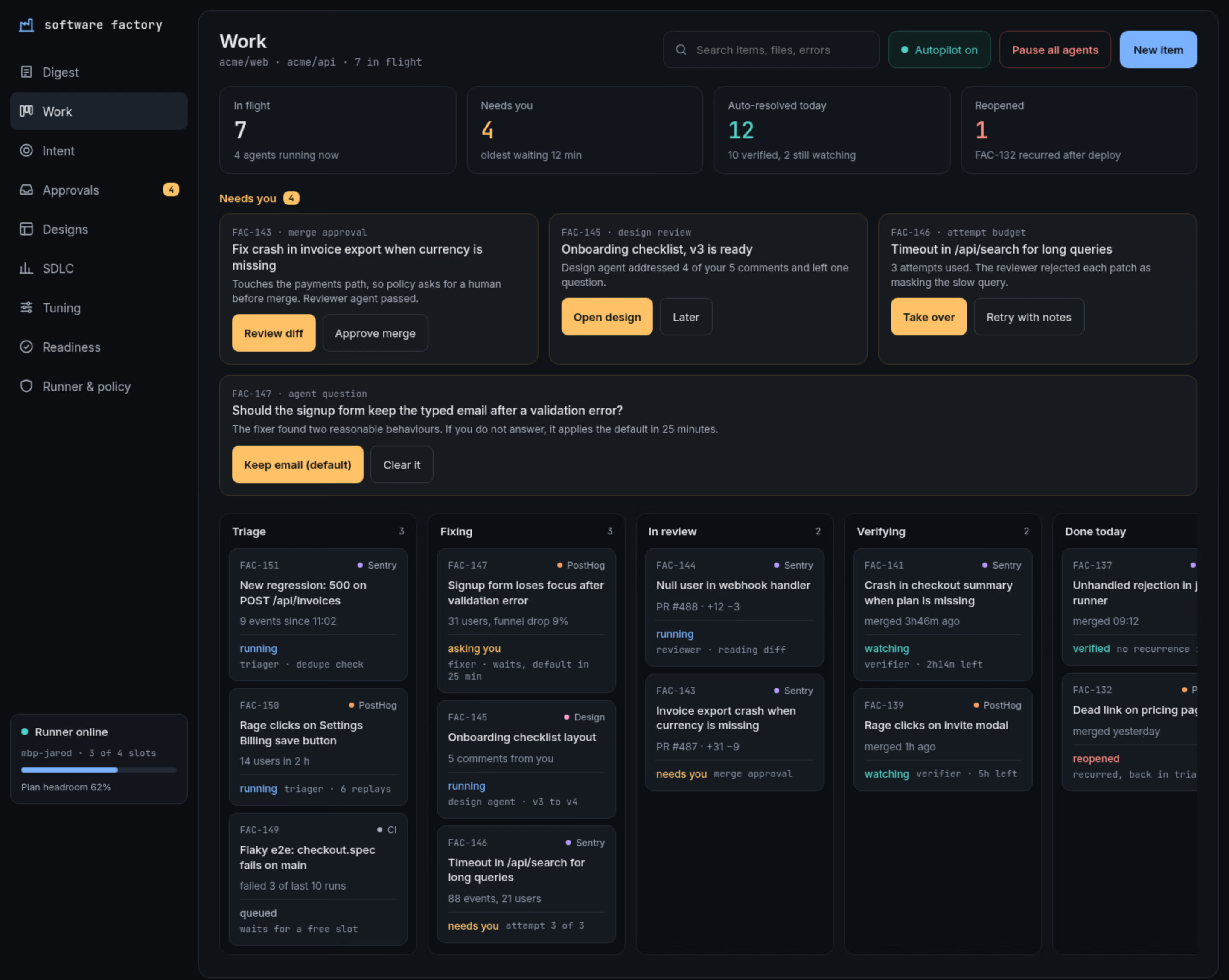
Work board
Everything in flight, from triage to verified. The top row is the only part that needs me: merge approvals on sensitive paths, a design review, a fix that ran out of attempts, and an agent question with a default and a deadline.
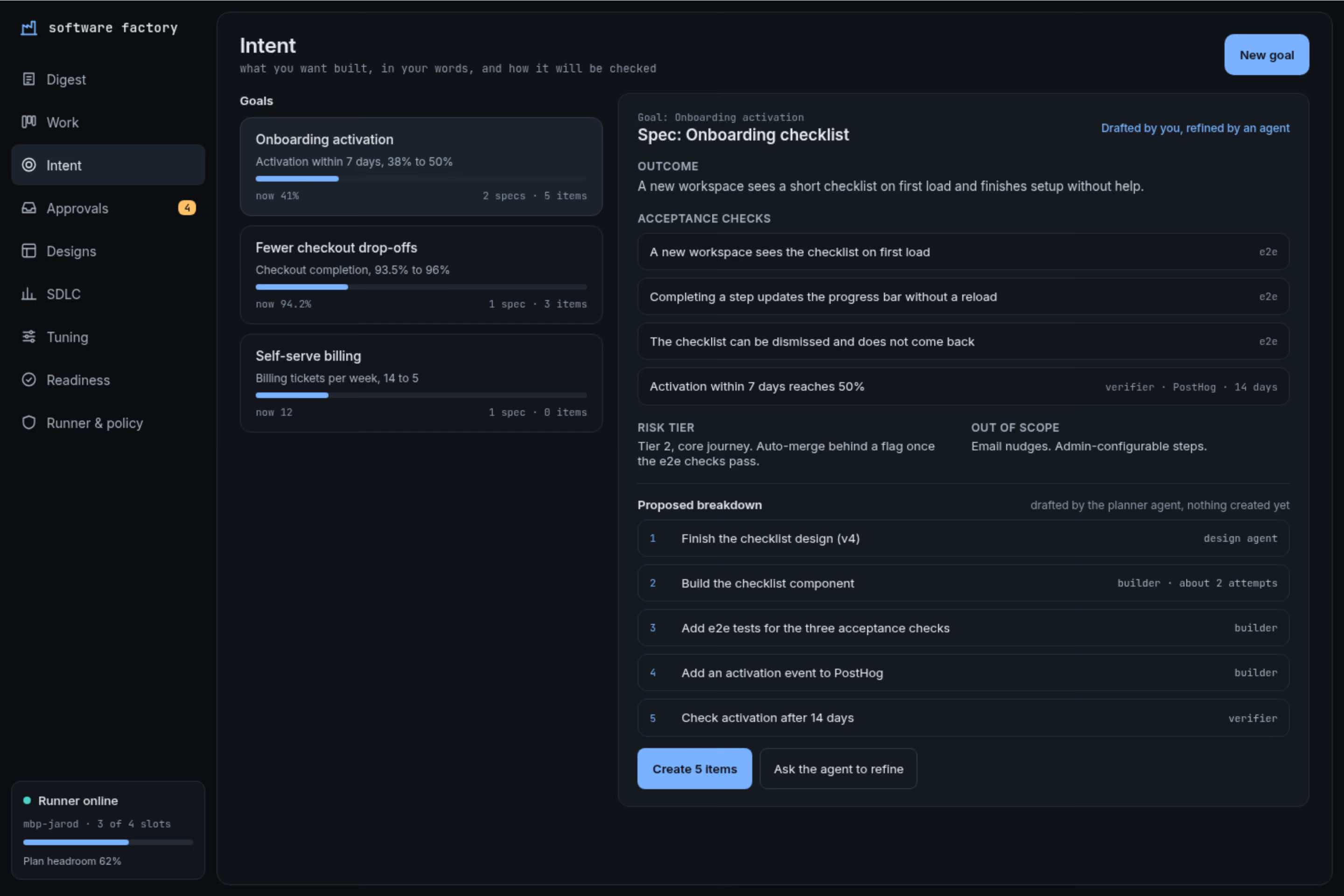
Intent
Goals in my words, with the number that says whether it worked. The spec has acceptance checks before any work exists, and the planner's breakdown waits for a yes.
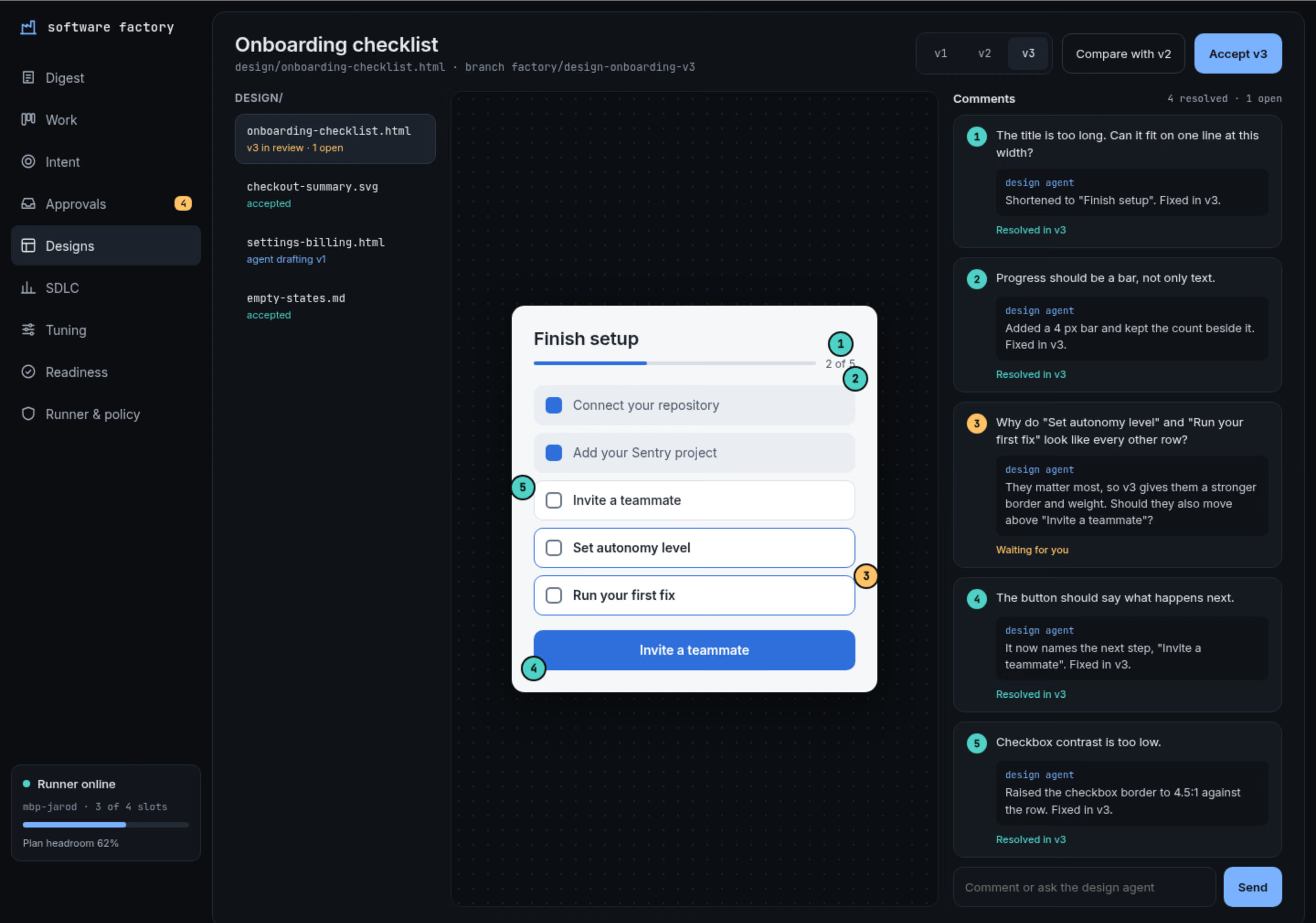
Design workspace
A design agent works through my comments version by version. Four are resolved in v3, and one comes back to me as a question.
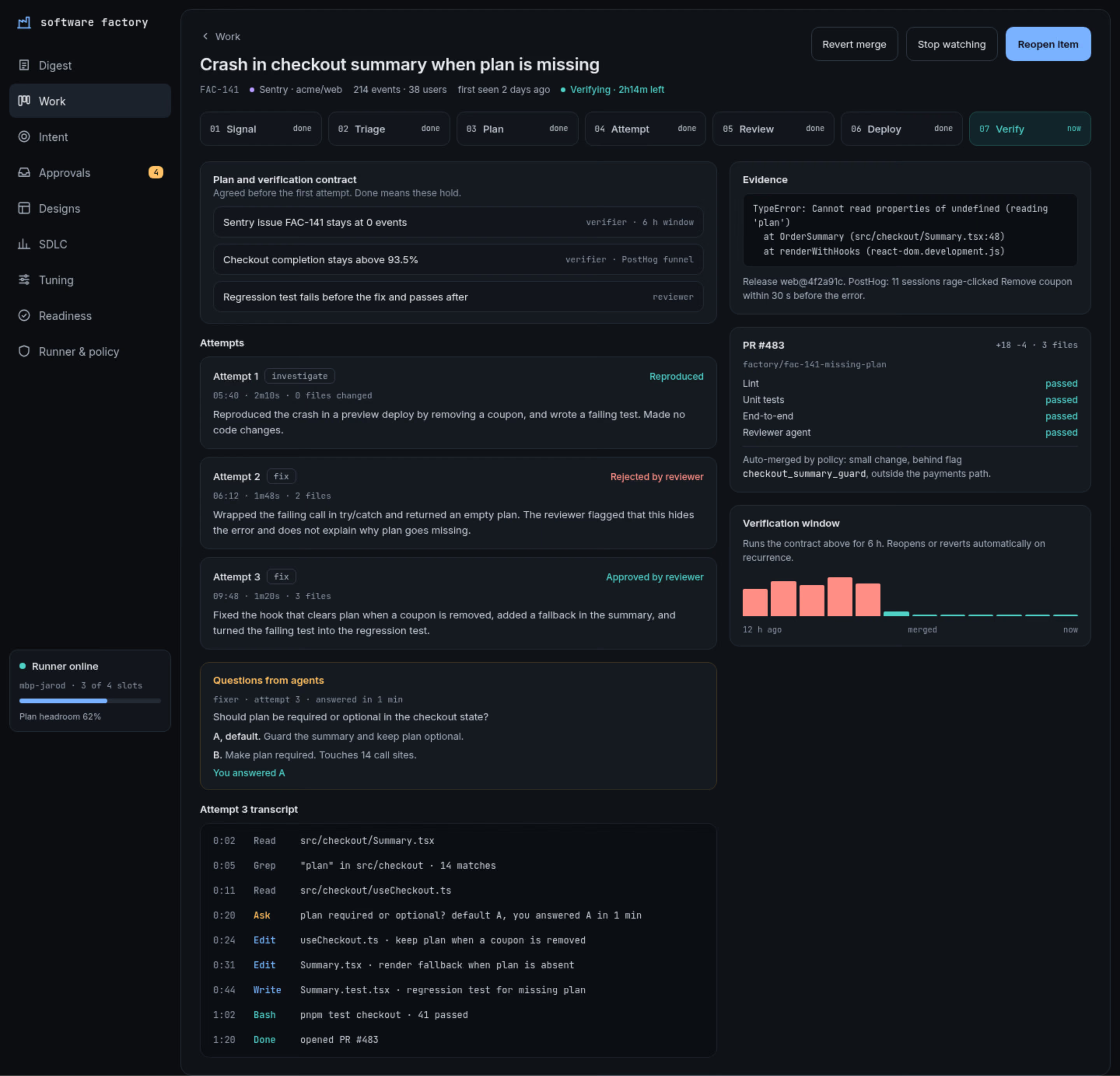
One item, end to end
A crash from signal to verify. Before the first attempt the agents agree on what done means. Attempt 2 got rejected for wrapping the error in a try/catch. Attempt 3 fixed the cause, and the verification window is still watching.
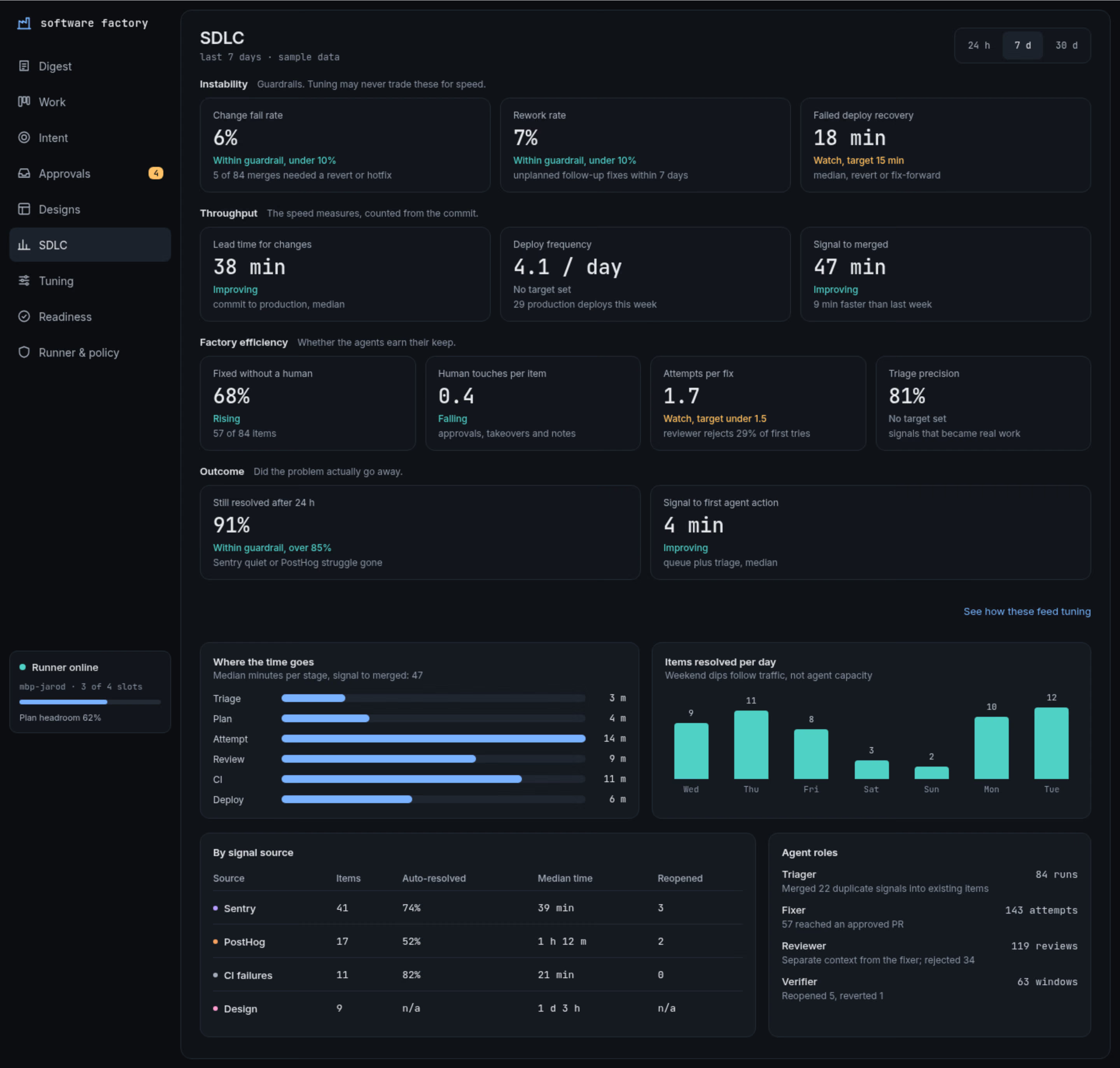
SDLC metrics
DORA-style measures plus whether the agents earn their keep. Change fail rate and rework are guardrails. Tuning is never allowed to trade them for speed.
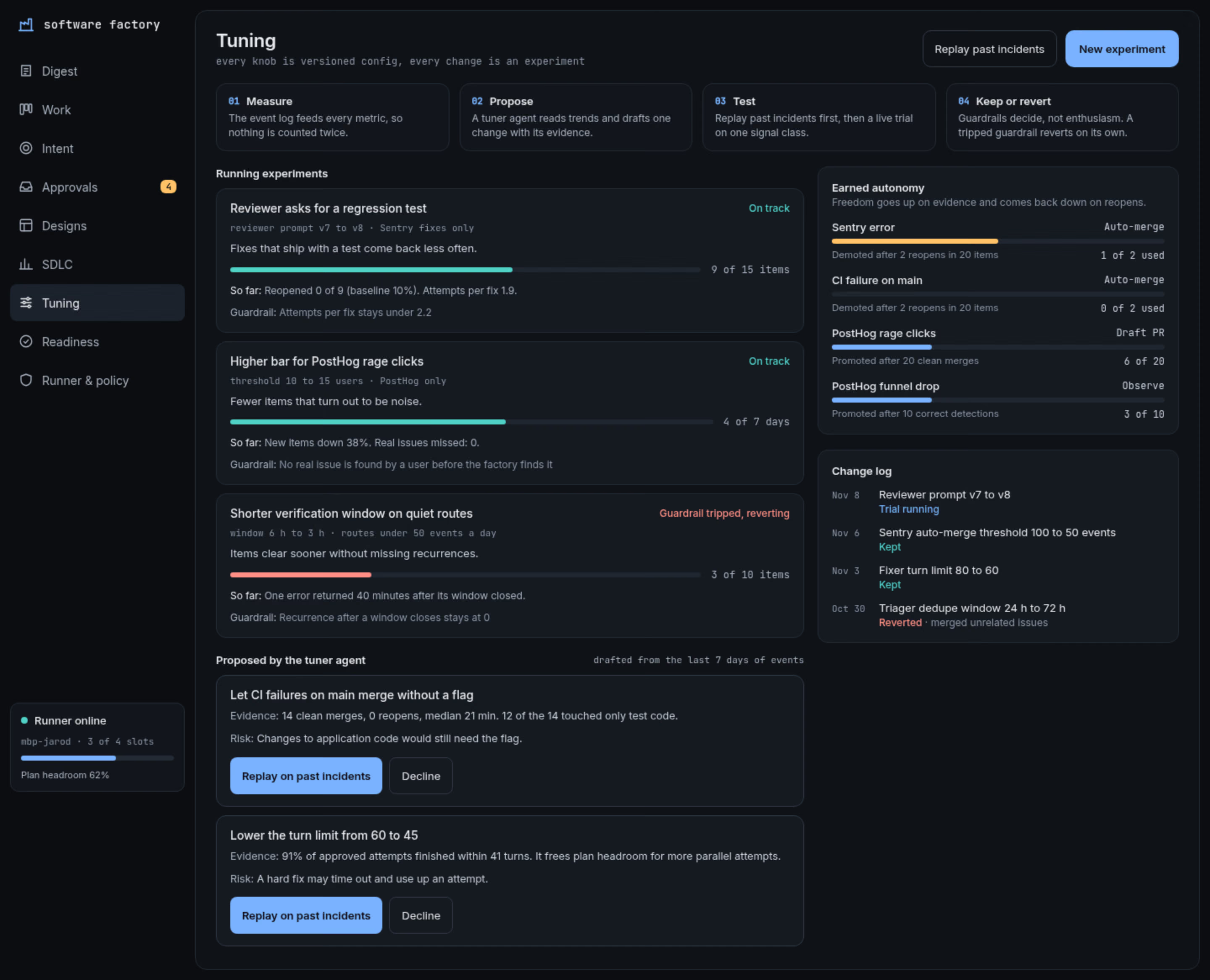
Tuning
Every knob is versioned config and every change is an experiment. A tuner agent proposes a change with evidence, it gets replayed on past incidents first, and a tripped guardrail reverts on its own. Autonomy goes up on evidence and back down on reopens.
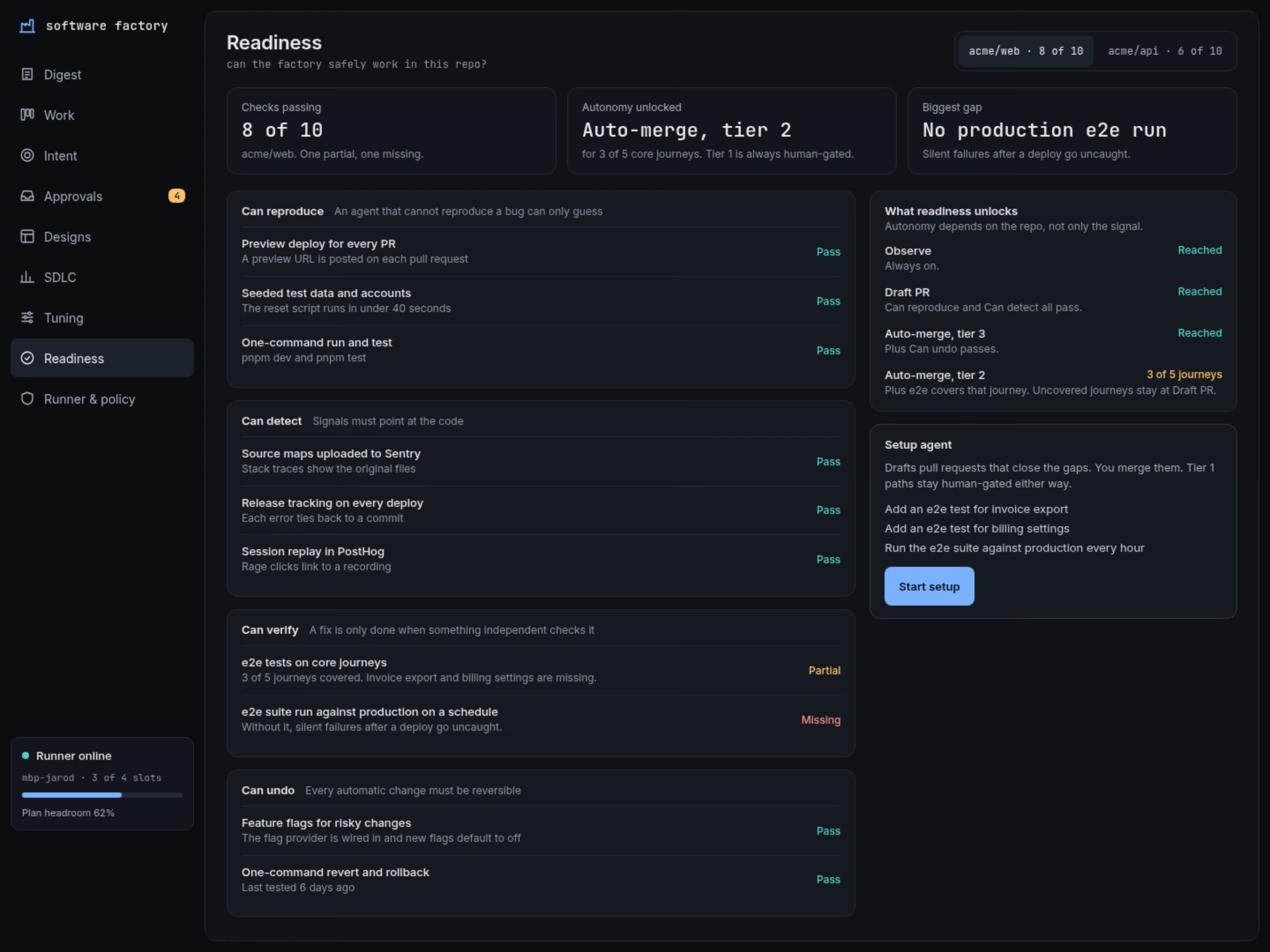
Readiness
Can the factory safely work in this repo? Preview deploys, source maps, e2e coverage, feature flags, one-command rollback. Autonomy depends on the repo, not just the signal.
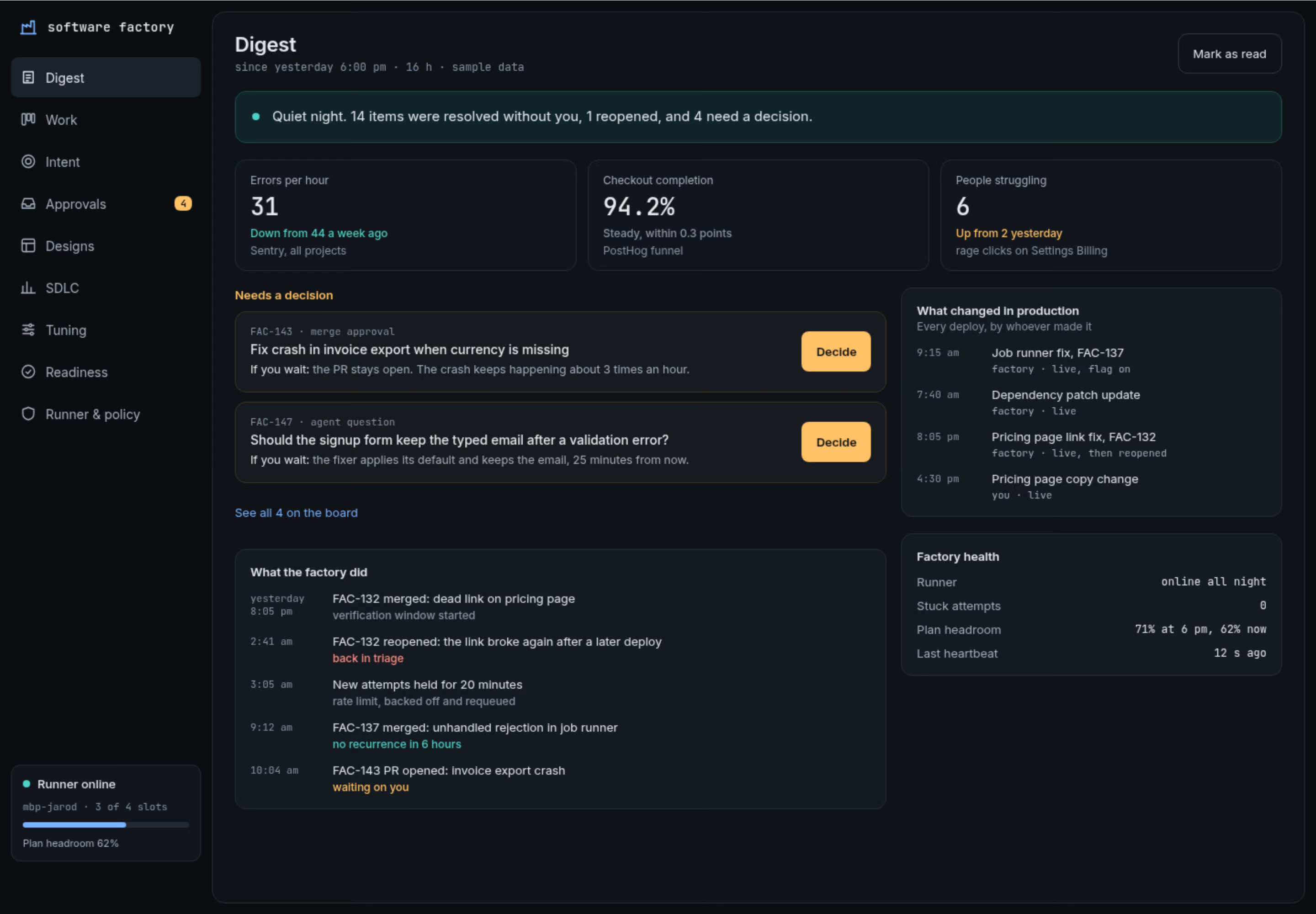
Morning digest
Overnight in one screen: what got fixed without me, what reopened, and the decisions waiting on me.
What I hold it to
The reviewer is a goldfish
It starts fresh, with no memory of the fix. It sees the plan, the diff and the check output, and nothing the fixer talked itself into.
Done means the problem went away
A merged PR isn't done. A quiet error count six hours after the deploy is.
Attempts are budgeted
Three tries, then a person. An agent that loops forever burns money and hides the hard problems.
The model's verdict is one input
Auto-merge also needs path rules, green CI with a clean Baseline scan, size limits and a daily cap. A prompt-injected PR can still talk a reviewer into passing it.
If your team is working out how to build with agents, I'd like to talk. Email jarod@jarod.is or find me on LinkedIn.